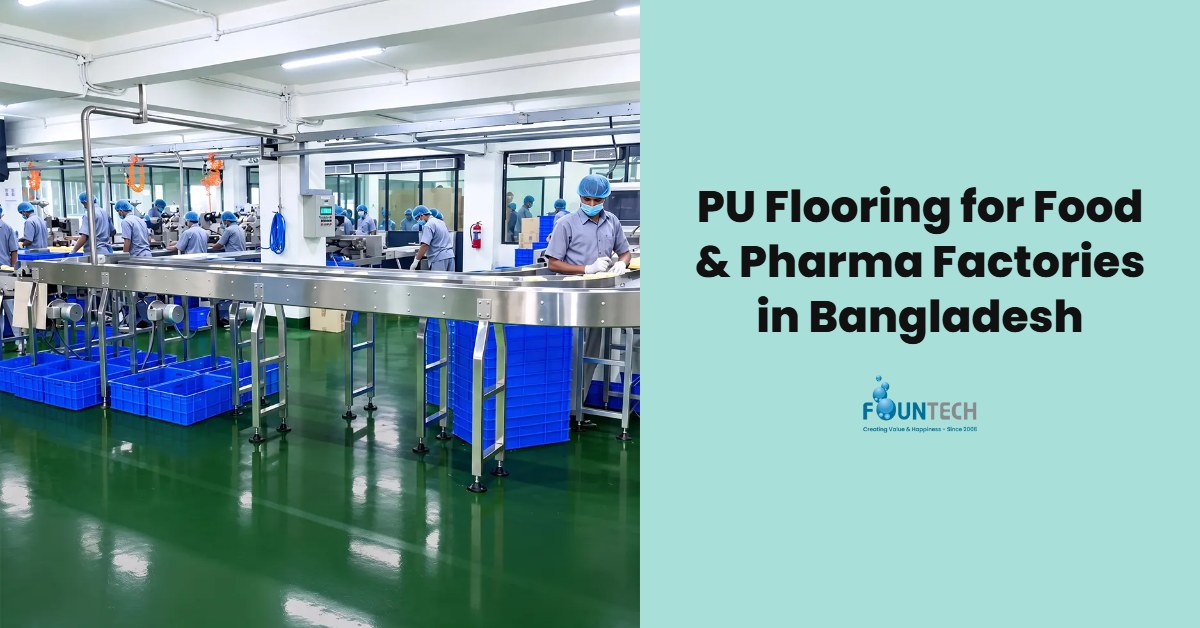
PU concrete is the most reliable floor for food and pharmaceutical factories. It is seamless, handles hot washing and steam, and resists acids, fats and sugar. That keeps the floor hygienic and helps your plant pass buyer and regulatory audits.
Fountech has laid industrial floors for factories, pharma and food plants in Bangladesh since 2006. Here is what to check before you choose a floor.
Why ordinary floors fail in food and pharma plants
- Bare concrete is porous. It absorbs liquids and holds bacteria.
- Tiles have grout joints. Joints crack and become dirt traps.
- Standard epoxy is hard but brittle. Hot water and steam can crack or lift it.
What a hygienic factory floor needs
- Seamless surface with no joints where dirt can collect.
- Hot-wash and thermal shock resistance for daily cleaning with hot water or steam.
- Chemical resistance to lactic acid, fruit acids, fats, sugar and cleaning chemicals.
- Anti-slip finish for wet process areas.
- Coved skirting where the floor meets the wall, so corners are easy to clean.
- Correct slope to drains so water never stands on the floor.
PU concrete meets all six when it is designed and installed correctly.
Which PU system for which area?
| Area | Recommended system | Thickness |
|---|---|---|
| Wet processing, wash areas, kitchens | PU concrete, anti-slip | 6–9 mm |
| Cold rooms and freezers | PU concrete | 6–9 mm |
| Pharma production and clean rooms | PU self-levelling, smooth | 2–4 mm |
| Packaging and dry storage | PU self-levelling or PU coating | 2–3 mm |
| Corridors and light areas | PU coating | about 1 mm |
Heavy-duty PU concrete is typically rated from about -40°C to +120°C, so one system can cover both a freezer and a hot-wash zone.
Food factory vs pharma factory: what changes?
Food and beverage plants need maximum thickness, anti-slip texture and resistance to fats, sugar and acids. Dairy, bakery, meat and juice lines fall here.
Pharmaceutical plants need a smooth, dust-free and easy-to-clean surface. Production and packing rooms often use self-levelling PU, with coving at all wall joints.
Cost of PU flooring for factories
Material starts from 45 Tk per sq ft at 1 mm and rises with thickness (2 mm: 90 Tk, 3 mm: 135 Tk, 4 mm: 180 Tk). Application costs about 20 Tk per sq ft on average. So with supply and application included, PU flooring costs about 155 Tk per sq ft at 3 mm (the standard for most factories) and 200 Tk per sq ft at 4 mm. Thicker PU concrete for wet areas costs more, but it saves you from repair shutdowns. See full pricing on our PU flooring in Bangladesh page.
How Fountech installs PU flooring
- Site survey and moisture test of the concrete
- Surface preparation by grinding or shot blasting
- Crack and joint repair
- Primer application
- PU screed or self-levelling layer, plus coving
- Finish coat and curing before handover
Good preparation is what makes a floor last. Most floor failures start with a weak base.
Frequently asked questions
Is PU flooring food safe?
Yes. Cured PU floors are widely used in food plants because they are seamless and easy to clean.
Can PU flooring be installed while the factory is running?
Often yes, by working in phases. We plan the work around your production schedule.
How long does PU concrete take to cure?
It depends on the system and temperature. Your project plan will show exact handover times.
Is PU better than epoxy for pharma?
For wet or hot areas, yes. For dry rooms, epoxy can work. Read Epoxy vs PU Flooring for the full comparison. Prefer Bangla? Read পিইউ ফ্লোরিং কী.
Plan your factory floor with Fountech
Tell us your area, process and cleaning method. Our team will visit and recommend the right PU system. Call 01844-652497 to book a free site survey.